



Writer: Joshua Williamson
Artist: Dan Mora
DC Comics, January and February 2026
This series ties directly into DC Comics’ current multi-character surreal adventure, called DC KO, which we have previously reviewed: see DC KO #1 (review) – World Comic Book Review . Here is DC Comics’ brief promotional copy for issue 1:
Experience Batman’s epic journey during the explosive DC K.O. event! The Dark Knight is forced to take a different path in the tournament for the Heart of Apokolips—one that has turned Gotham into a deadly arena where Batman must battle against the Batmen of the future! Who are these Batmen?
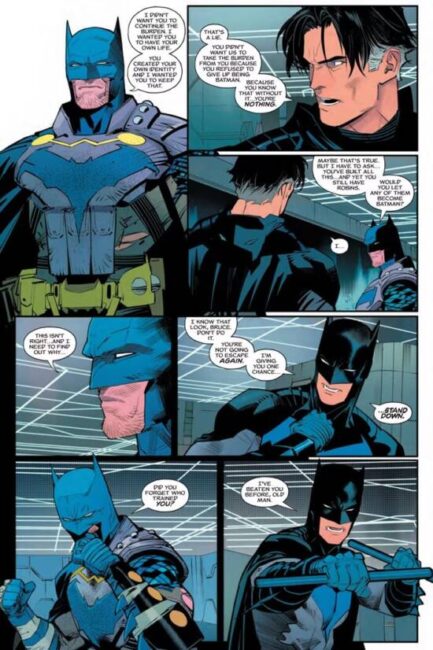
Batman “cheated”, as it evolves, in the first issue of DC KO. Somehow he managed to survive the Joker’s harpoon through the chest using a device from Apokolips, the homeworld of perennial DC Comics villain Darkseid. Batman instead is taken on his own multiversal ride by a quintessential thing of evil, called “the Heart of Apokalips”. In the first two issues, Batman confronts a Nightwing version of Batman, and the second involving the anti-hero Red Hood as Batman. Each is a different future reality.
In June 2023, The Economist magazine strangely published not one but two articles on the use of the multiverse in popular culture. The first was entitled, “Why Hollywood is obsessed with the multiverse“, in which the writer perceived motion pictures featuring different reality versions of characters as a way to polish tired intellectual property rights. The second article, https://www.economist.com/united-states/2023/06/22/why-the-multiverse-is-eating-popular-culture saw the multiverse as a therapy tool. (Perhaps one of these stories is an alternate reality version of the other?)
And so we approached Knightfight with the sort of resolute bleakness that one has when laying down mouse traps. The multiverse is not very clever anymore. When DC Comics published Crisis on Infinite Earths in 1987, shutting down its multiverse for at least a decade, this was not a lockdown of imagination but instead an exercise in editorial discipline so as to better engage new readers. No reader new to DC Comics in 1987 could follow the distinction between Earth-1, Earth-2, Earth-3, Earth-S, Earth-X, Earth-Prime, and so on. Over thirty years later, the pestilence of alternate realities has again over-run DC Comics’ continuity.
But to our surprise, Knightfight is something different. Batman’s psyche has been probed in a multitude of ways over the years. (Is he a clinically depressed billionaire with a sadomasochistic fetish to beat up poor people? Is he an orphan who throws his child army into the sort of danger which led to his parents being killed in Crime Alley? Did he actually eat rats in his stinking cave?) Here, though, Batman is being repeatedly told that he is not actually Batman: that either he has been replaced by Nightwing in issue 1, or that he is Clayface by Red Hood in issue 2. Batman’s grip on reality is repeatedly shaken, in different ways, by those closest to him. “Do you even know yourself anymore, Bruce?” asks Grayson. And Jason Todd: “Listen to yourself? Yelling at the sky?!”

If pages six and seven had not been incorporated into the story, this title would be quite a different thing. Those two pages tie Knightfight back to DC KO. But what if they were not there, explaining how it is that Batman is being pinged around a multiverse of futures? Without those pages, the storyline recalls Shutter Island, a 2010 motion picture featuring Leonardo DiCaprio as an imprisoned murderer whose psychotic fictions are permitted to play out, resulting in his restoration to sanity. Knightfight could have been the same sort of psychological thriller, where the reader, as well as Bruce Wayne, is not quite sure whether or not Batman is actually Batman. It is a genuine shame writer Joshua Williamson was not allowed to build suspense through ambiguity about Bruce Wayne’s state of mind, and instead the story was shoehorned into the greater narrative of DC KO.

Small Easter Eggs should otherwise satisfy devoted readers. Ambush Bug’s effigy on page 7 confirms his squished death in the DC KO tournament: Red Hood’s use of a cattle prod, once viciously deployed by another Batman doppelganger, Midnighter, in Mark Millar’s and Frank Quietly’s The Authority (2000): the quarantine of Gotham City in a red dome, resembling the original Red Hood mask, echoing the fate of the Superman’s Bottled City of Kandor: the use of Clayface in the Jason Todd arc is a nod to Jason Todd’s resurrection faked by Clayface in Jeph Loeb’s and Jim Lee’s Hush (2003).
On the art: we have to credit artist Dan Mora with the exceptional job he did of rendering the faces and costumes of the alternate future reality Batmen. The Dick Grayson Batman is smooth-shaven, unlike stubbly Bruce Wayne, and the costume looks like a logical evolution from Nightwing uniform. The Jason Todd Batman is also an orderly progression from the Red Hood’s standard costume (and perhaps a touch of the Jean Paul Valley version of Batman from 1992). Batman himself looks like he has been thrift-shopping with Jack Kirby’s Hunger Dogs, but the amalgamation of Big Barda’s uniform into the usual Bat-appearance is striking.
