



Writer: Max Ferrada
Artist: Ben Worrell
Comx Studio, 2024
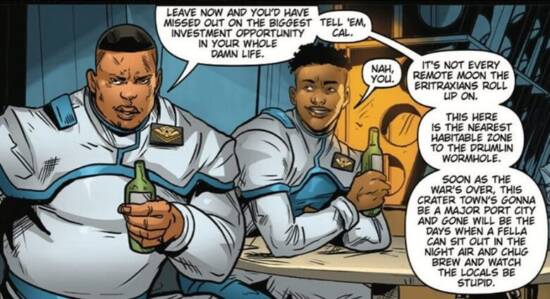
Stellarlands is an independently produced comic written by Australian author Max Ferrada, with art by Ben Worrell. Across its first two issues—84 pages in total—the series lays down an ambitious foundation for a shared universe that feels far more interested in long-term consequences and world-building than in traditional superhero spectacle. It was the subject of a successful Kickstarter campaign last year: see STELLARLANDS – An epic sci-fi saga by ComX Studio — Kickstarter
While the book does feature superpowered individuals (or “metahumans,” to borrow the increasingly common term coined by American publisher DC Comics), Stellarlands doesn’t sit comfortably in the superhero genre. The metahumans are important, but they’re not the point. The story reads much more like a space opera, with corporate interests, interstellar politics, and the lingering fallout of war taking center stage.
Both issues work as standalone stories while also clearly belonging to the same universe. That is a tricky balance to pull off, but Stellarlands manages it well. Each issue tells a complete narrative while quietly adding new layers to the setting, making the Stellalands universe feel broader and more lived-in with every chapter.
The first issue introduces Daffney, a metahuman operating under the corporate codename “Anvil Liza”, named after her corporate sponsor, the space mining company AnvilCore. (For an interesting take on corporations in science fiction, we recommend Unemployed Negativity: Corporate Imaginations: In Praise of Weyland-Yutani .) On the surface, her abilities are familiar: flight, super strength, and near-invulnerability put her firmly in “Superman-type” territory. But Ferrada wastes little time in signaling that this is not that kind of story. Liza is a well-defined character with clear personal issues, including alcoholism—made more complicated by the fact that her altered physiology paradoxically makes her resistant to alcohol.
Her mission is deliberately mundane in its framing. She’s sent to Wexford Downs, a classified support station built decades earlier for an intergalactic war and long since abandoned. The station may have been revisited—or even recommissioned—by an alien faction known as the Pelothraxils. Liza’s understanding of the job is simple: destroy the station so it can’t be used again. A cleanup operation, nothing more.
Despite Liza being the most immediately recognizable figure, she isn’t the true focal point of the issue. Much of the story is devoted to establishing the larger Stellarlands setting, particularly the history of the first intergalactic war. Through dialogue and faux-commercial interludes, Ferrada outlines a messy, almost absurd chain of events: Earth and the Pelothraxils wage war, only to be attacked by the Trivarians once both sides are weakened. Then, just as that conflict escalates, a new fleet—the Ormulacs—enters the picture, forcing all three factions into an uneasy alliance. It’s presented with a dry, almost comedic tone, but the implications are grim. Decades of warfare and staggering loss of life treated as just another chapter in galactic history.
The emotional core of the issue emerges when Anvil Liza encounters two young survivors, the children of former soldiers who have been stranded on the station for decades. Cut off from communication, they have no idea the war is over, let alone that their side lost. They respond to Liza as enemies would, attacking a being who is effectively indestructible. The result is predictable, but the aftermath is where the story gains real weight. Once the misunderstanding is resolved, Liza decides to help them get home, all while armed Pelothraxil forces attempt to reclaim the station.
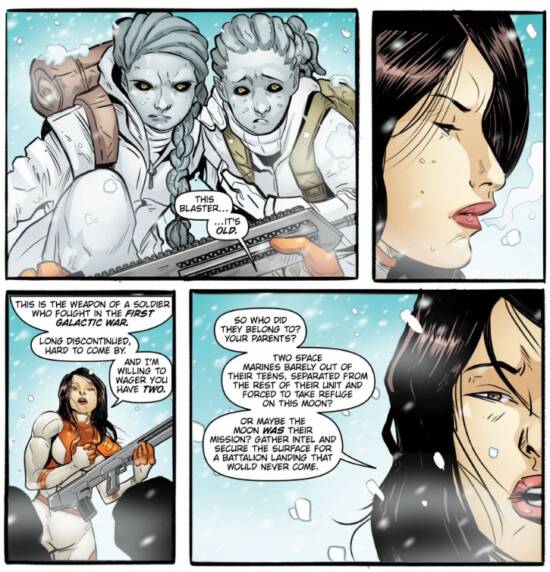
This is where Mr Ferrada’s writing stands out. What initially feels like a familiar setup—a powerful protector escorting vulnerable innocents—slowly becomes something more uneasy. The children don’t fully trust Liza, and Liza herself is not acting out of pure heroism. She’s a corporate-sponsored black ops asset, sent on a discreet mission with very specific objectives. The tension between duty, empathy, and institutional indifference drives the story toward an ending that may catch readers off guard and firmly establishes that Anvil Liza is not a stand-in for Superman, morally or narratively.
Ben Worrell’s artwork supports the story effectively, favoring clarity and atmosphere over flashy excess. The environments feel functional, the characters grounded, and the overall visual tone reinforces the sense that this is a universe shaped by logistics, war, and corporate influence rather than idealized heroics.
Taken together, the first two issues of Stellarlands suggest a series that’s less interested in saving the galaxy than in examining what happens after the wars are supposedly over. It’s an ambitious indie comic that treats superpowers as just another tool in a much larger system, and that restraint gives the story a weight many larger titles lack. If you’re looking for something that leans more toward space opera than superheroics, Stellarlands is well worth your time.
For more information about this title, please follow @stellalands_comics on Instagram.