


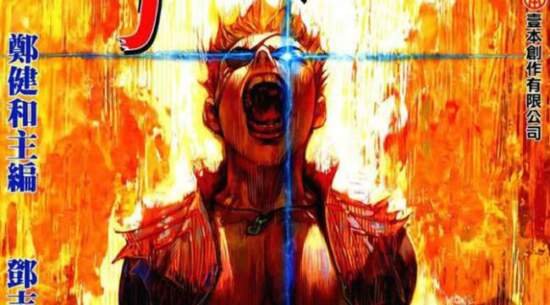
Writer: Dennis Hopeless
Artist: Kev Walker
Marvel NOW!, December 2012
It is probably no spoiler by now that a minor plot development in the 2025 Thunderbolts* movie released by Marvel Studios is the execution of an assassin named Taskmaster. This unsatisfying death of an intriguing character was done so because the story was a little “bloodless” – see ‘Thunderbolts’ director explains Taskmaster’s death .
The rationale for Taskmaster’s death in the motion picture reminded us, however, of a limited series called Avengers: Arena, published by Marvel Comics in 2012. The title was written by Dennis Hopeless and with art by Kev Walker. The title contains a sea of blood.
The plot will be recognisable. A villain named Arcade (a character with a long history of ridiculousness in Marvel Comics’ continuity) decides that he is going to carve out for himself the reputation he deserves. To that end, he builds a facility on an island (which as ever he calls “Murder World”) where he is virtual god, able to create and destroy as he sees fit. Arcade then populates the island with teenaged superheroes from the Avengers Academy in the United States, the Braddock Academy in the United Kingdom, two of the characters from Runaways, plus a few extras. Arcade gives them all a week, and says only one may survive, and then, at least for a while, leaves them to it. (The similarity to the novel and movie series The Hunger Games is acknowledged by Arcade in the text, and by writer Dennis Hopeless in his postscript.)
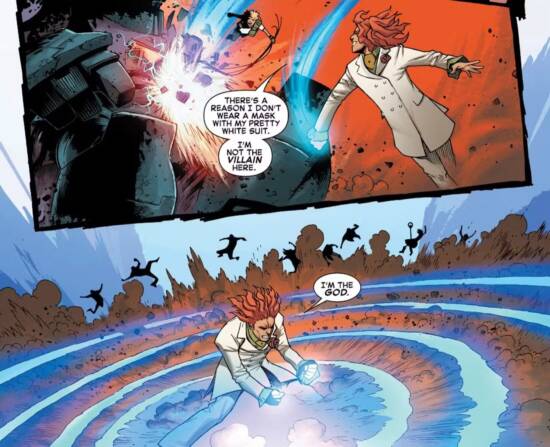
The attraction to the story lies in how the characters are all ostensibly altruistic, yet have flaws within and differences between them so that when placed under pressure they start to attack and even murder each other. There is no reason why all of these superheroes-in-training should be friends. They fall into groups. Some do not know others, and some really do not like each other at all.
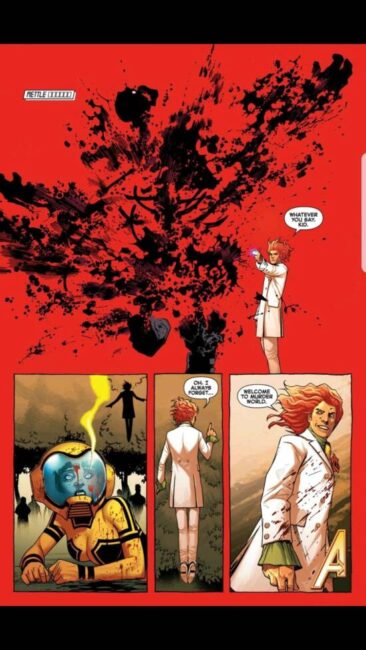
Granted that many of the characters in the title are obscure, but the death toll is shocking for a mainstream superhero comic book:
- Juston Seyfet, from the endearing 2003 title Sentinel, has his devoted, re-programmed mutant-hunting robot destroyed, himself paralysed from the waist down, and later killed;
- the insufferable Kid Briton, an alternative universe version of Captain Britain, is decapitated during an argument by the axe-wielding reincarnated Celtic warrior named Anachronism;
- Nara, an exiled Atlantean, is crushed to death by a new character, Callum Bloodstone, who can turn into an enormous, mindless demonic axolotl called a Glartrox;
- Mettle, a repeat character from Avengers: Academy, is blown up by Arcade. Later, Mettle’s super tough red shelled body is horribly animated by Arcade to throw off the scent the only two Avengers who are concerned about the disappearance of the young superheroes;
- Red Raven, a “bird-person” from a 1992 storyline involving the Sub-Mariner, tries to escape early but hits an invisible dome above the island and falls to her death;
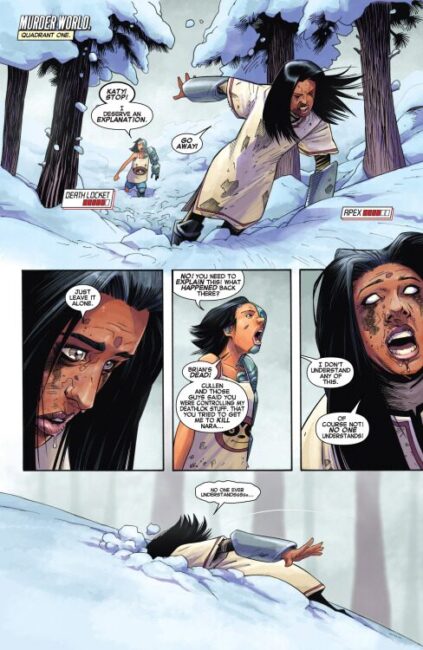
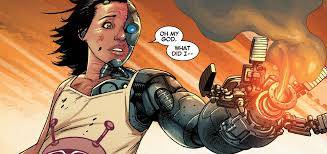
- Apex, the most Machiavellian of characters who is possesses two personalities of different genders in the same body (kind of) is killed by Beckie Ryker (Death Locket), a terrified young girl who has been transformed into a killer cyborg known as a Deathlok by her insane father.
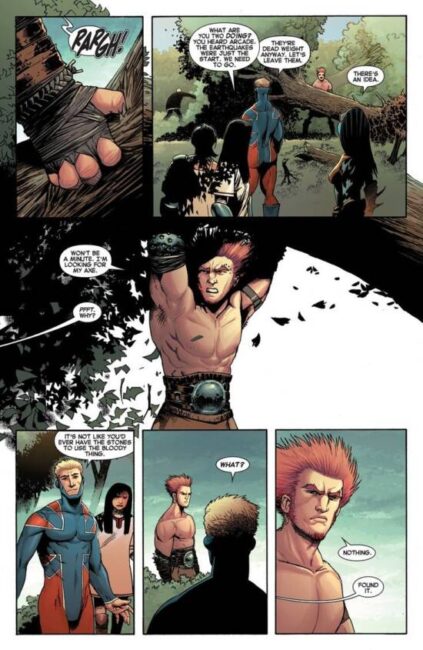
In addition, the sorcerous Nico Minoru from Runaways has an arm blown off; Reptyl from Avengers: Academy is almost incinerated twice (once by Death Locket, and the second time by an out-of-control fellow member of Avengers Academy, Hazmat); and Wolverine’s nigh-unkillable clone, Laura McKinney (also known as X-23) is burned down to the skeleton by Hazmat. Peril and sudden death haunt the title.
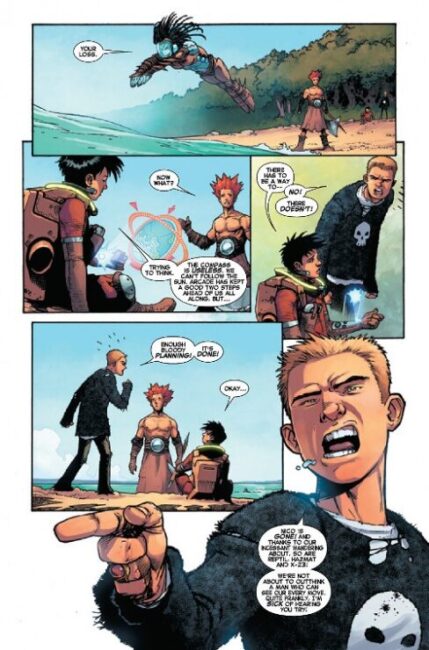
This title is not just an exciting read because of the ugly casualty rate. It is also how the characters react to the danger. The art by Kev Walker is not just concerned with the plentiful action scenes. It is captivating because of the expressions – the teens’ faces and body language plainly exhibit uncertainty, frustration, mania, horror. Some are on their toes: Cammi, a young girl who was involved the with intergalactic team Guardians of the Galaxy, is very capable and out to survive. Apex is out to capitalise on the chaos. Hazmat was saved by the sacrifice of her boyfriend Mettle in the first issue, and then goes into a state of complete denial and spends several days sunbaking on a beach. Death Locket, built to survive a nuclear war, is in constant distress, unable to cope with what is going on, and is manipulated by Apex. Nara surprises herself at the end of her life through self-sacrifice. The dialogue is smart, too, with some of the best lines reserved for the deeply sardonic Cammi.
This title over a sequence of eighteen issues explores the backstories of a lot of characters, including how Arcade resolved to become a genuinely murderous threat. Despite being cornered in the story’s climax, Arcade manages to spirit himself away and is happy to have created for himself the name he always wanted as a murderous manipulator. The character merrily shares clips of the bloody action on social media. It is very unusual for a villain in the American superhero genre to achieve such complete mayhem within a plot, and then walk away completely unscathed. (There is no Scooby-Doo “I would have gotten away with it but for you meddlesome kids” here.)
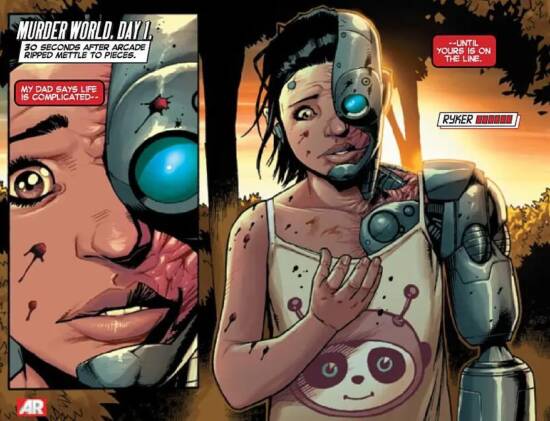
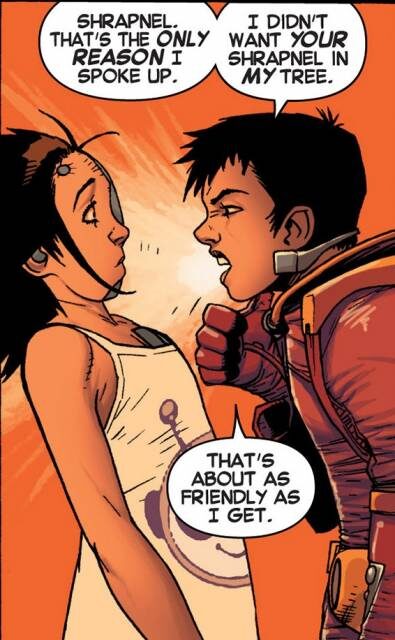
But in our mind, this is Death Locket’s story. Beckie was once a young girl who liked swimming, until a Deathlok from the future killed her mother and maimed her in a failed attempt to kill her father. As one of Arcade’s odds-on favourites to survive the conflict simply by reason of her mechanical additions (we cannot call them “enhancements” because they are too horrible), Death Locket’s story is filled with terror, betrayal, and finally, brutal decision-making on Apex’s fate. (There are some similarities between Death Locket and the Marvel Cinematic Universe’s Taskmaster – both are terribly scarred as a consequence of an assassination attempt upon their respective fathers, both are physically controlled by puppet-masters.) Death Locket’s story is to do with the destruction of Beckie’s innocence, and it is a miserable thing to watch it unfold. Beckie’s singlet is symbolises her descent. At the beginning of the story, it is clear and features a quirky panda. By the end, it is soaked in splattered blood. (It is a shame that, in the sequel Avengers: Undercover, and in subsequent titles, Marvel Comics succumbed to temptation to make Death Locket a villain.)
Avengers: Arena has not aged at all over the past 14 years. It is a thrilling, horrifying, captivating superhero story.